Grinding Your Teeth at Night? YourBreathing May Be Part of the Story
It might start with a chipped molar. Or a jaw that feels sore before breakfast. Or a partner who says you sound like you’re chewing rocks at 2 a.m.
When patients bring this up at 805 Dentistry in Thousand Oaks, many have already been told the cause is stress and the fix is a night guard. Stress is a real factor. But for a lot of people who grind, another piece of the puzzle rarely gets discussed: what’s happening with their breathing while they sleep.
Researchers have been studying the overlap between nighttime grinding, known as sleep bruxism, and obstructive sleep apnea for more than 20 years. The science isn’t fully settled, and experts still debate exactly how the two are connected. But they show up together often enough that grinding deserves a closer look, especially if you also snore, wake up tired, or start your day with a headache.
How Grinding and Breathing Are Connected
What exactly is sleep bruxism?
Sleep bruxism is repeated jaw muscle activity during sleep, including grinding, clenching, or both. An international panel of bruxism experts now describes it as a behavior rather than a disease in otherwise healthy people, one that can raise the risk of certain problems (Lobbezoo et al., 2018).
It’s also common. In a survey of more than 13,000 people in the United Kingdom, Germany, and Italy, about 8% reported grinding their teeth during sleep at least once a week (Ohayon et al., 2001).
Most people who grind never hear it themselves. The clues tend to be indirect: flattened or cracked teeth, tight jaw muscles in the morning, or a bed partner who notices the sound.
Why would grinding have anything to do with breathing?
It comes down to how grinding gets triggered. Sleep lab research shows that grinding episodes typically follow micro-arousals, which are brief bursts of brain and heart activity that pull you toward lighter sleep without fully waking you (Kato et al., 2001).
Sleep apnea produces a steady stream of those arousals. Each time the airway narrows or collapses, the pause in breathing often ends with the brain briefly stirring to get air moving again (Martynowicz et al., 2019).
In a study of men who had both conditions, most grinding episodes happened right after a breathing pause ended, often within seconds (Saito et al., 2014). Some researchers have even suggested that for people with sleep apnea, grinding may play a protective role, though that idea is still unproven (Li et al., 2023).
How common is it to have both?
More common than most people would guess. In the large European survey, people with obstructive sleep apnea were about 1.8 times more likely to report grinding, the strongest link of any sleep disorder the researchers examined (Ohayon et al., 2001).
More recently, a study of 914 adults with sleep apnea, each monitored overnight in a sleep lab, found that nearly half of them (49.7%) also had sleep bruxism (Li et al., 2023).
In that same study, men and people with a lower body mass index were more likely to grind (Li et al., 2023). That second finding matters, because many people assume sleep apnea only affects people who are overweight. Grinding can be a useful clue in patients who don’t fit that picture.
Does grinding mean I have sleep apnea?
Not necessarily. Stress, anxiety, caffeine, alcohol, tobacco, and certain medications are all recognized risk factors for grinding too (Martynowicz et al., 2019).
The research on the link also has a few twists. One sleep lab study found grinding was more frequent in people with mild to moderate sleep apnea than in people with severe sleep apnea (Martynowicz et al., 2019).
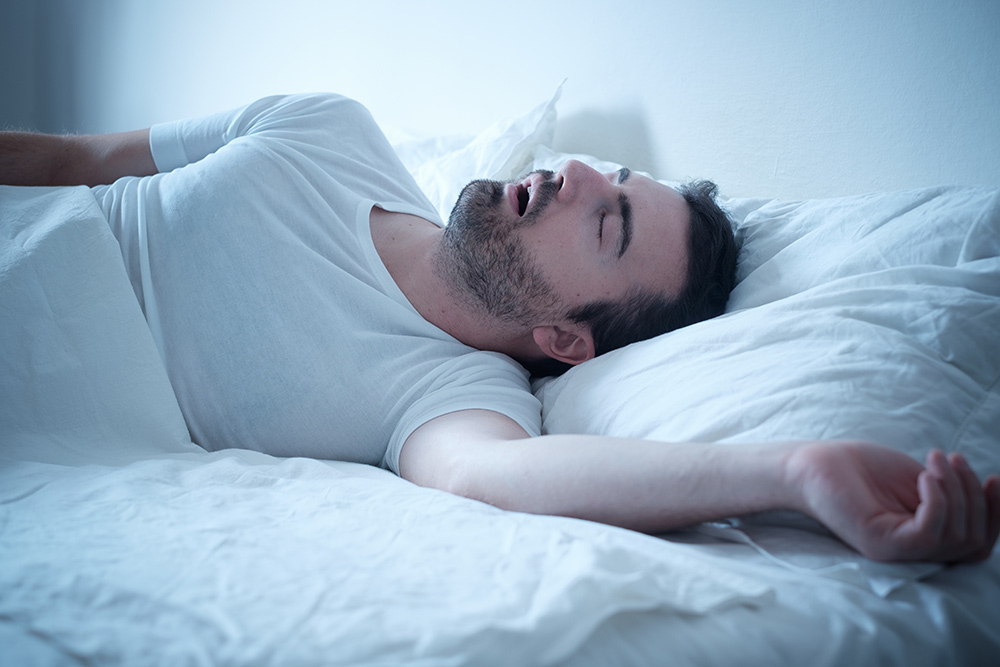
So grinding on its own doesn’t prove anything. What it does is give Dr. Radfar a reason to ask a few more questions. Grinding combined with loud snoring, gasping during sleep, morning headaches, or daytime exhaustion is a pattern worth checking.
I already wear a night guard. Is that a problem?
For most people, a night guard does what it’s designed to do: protect teeth from wear.
The concern is narrower. A standard night guard covers the teeth but isn’t designed to hold the lower jaw forward, so it doesn’t support the airway.
In a small randomized trial of people with sleep apnea, breathing interruptions were slightly higher on nights they wore a standard stabilization splint, although the difference was small (Nikolopoulou et al., 2013).
The takeaway isn’t that night guards are dangerous. It’s that a night guard can protect your teeth while a breathing problem goes unnoticed.
If you wear one, there’s no need to panic. Just mention any sleep symptoms at your next visit to 805 Dentistry so they can be checked.
Can treating sleep apnea reduce grinding?
Early research says it can. A study of 48 adults with sleep apnea looked at two treatments. One was CPAP. The other was a mandibular advancement device, a custom oral appliance that holds the lower jaw slightly forward to keep the airway open.
Grinding activity dropped significantly with both, with no meaningful difference between them (Martynowicz et al., 2022).
Earlier lab work found that short-term use of a mandibular advancement device sharply reduced grinding activity in people who grind, though more than half of the participants reported some soreness in the gums or front teeth (Landry et al., 2006).
Results vary from person to person. At 805 Dentistry, a physician confirms the sleep apnea diagnosis, and Dr. Dar Radfar, a Diplomate of the American Sleep and Breathing Academy, fits the custom oral appliance. That way the breathing and the grinding are both accounted for.
What should I do if I grind and also snore or feel tired all day?
Tell your dentist the whole story, not just the part about your teeth. Mention snoring, gasping or choking at night, morning headaches, and how alert you feel during the day.
At 805 Dentistry, Dr. Radfar can go over your symptoms with you, in the office or by telemedicine, and help arrange a home sleep test so a physician can review the results.
If sleep apnea is ruled out, a night guard may be all you need. If it’s confirmed, you’ll have options that address the breathing and the grinding together, instead of only cushioning the damage.
Why does 805 Dentistry ask about sleep when you come in for grinding?
For Dr. Radfar, it’s personal. In 2009, he fell asleep at the wheel and crashed his car, and that accident led to his own sleep apnea diagnosis.
When he couldn’t tolerate CPAP, he made his own oral appliance. Since then, sleep and breathing have been at the center of his work, and he now trains dentists across the country in dental sleep medicine.
That experience is why worn teeth and a sore jaw get a closer look in his chair.
Your Teeth May Be Telling You Something About Your Sleep
Waking up with a sore jaw and worn teeth is frustrating, especially when a night guard only absorbs the damage.
If you live in Thousand Oaks, Westlake Village, Newbury Park, or anywhere in the Conejo Valley, call 805 Dentistry at (805) 336-8478 and ask for a sleep apnea screening before your next night guard.
References
1. Kato, T., Rompré, P., Montplaisir, J. Y., Sessle, B. J., & Lavigne, G. J. (2001). Sleep bruxism: An oromotor activity secondary to micro-arousal. Journal of Dental Research, 80(10), 1940–1944. https://doi.org/10.1177/00220345010800101501
2. Landry, M. L., Rompré, P. H., Manzini, C., Guitard, F., de Grandmont, P., & Lavigne, G. J. (2006). Reduction of sleep bruxism using a mandibular advancement device: An experimental controlled study. The International Journal of Prosthodontics, 19(6), 549–556. https://pubmed.ncbi.nlm.nih.gov/17165292/
3. Li, D., Kuang, B., Lobbezoo, F., de Vries, N., Hilgevoord, A., & Aarab, G. (2023). Sleep bruxism is highly prevalent in adults with obstructive sleep apnea: A large-scale polysomnographic study. Journal of Clinical Sleep Medicine, 19(3), 443–451. https://doi.org/10.5664/jcsm.10348
4. Lobbezoo, F., Ahlberg, J., Raphael, K. G., Wetselaar, P., Glaros, A. G., Kato, T., Santiago, V., Winocur, E., De Laat, A., De Leeuw, R., Koyano, K., Lavigne, G. J., Svensson, P., & Manfredini, D. (2018). International consensus on the assessment of bruxism: Report of a work in progress. Journal of Oral Rehabilitation, 45(11), 837–844. https://doi.org/10.1111/joor.12663
5. Martynowicz, H., Gac, P., Brzecka, A., Poreba, R., Wojakowska, A., Mazur, G., Smardz, J., & Wieckiewicz, M. (2019). The relationship between sleep bruxism and obstructive sleep apnea based on polysomnographic findings. Journal of Clinical Medicine, 8(10), 1653. https://doi.org/10.3390/jcm8101653
6. Martynowicz, H., Wieczorek, T., Macek, P., Wojakowska, A., Poręba, R., Gać, P., Mazur, G., Skomro, R., Smardz, J., & Więckiewicz, M. (2022). The effect of continuous positive airway pressure and mandibular advancement device on sleep bruxism intensity in obstructive sleep apnea patients. Chronic Respiratory Disease, 19, 14799731211052301. https://doi.org/10.1177/14799731211052301
7. Nikolopoulou, M., Ahlberg, J., Visscher, C. M., Hamburger, H. L., Naeije, M., & Lobbezoo, F. (2013). Effects of occlusal stabilization splints on obstructive sleep apnea: A randomized controlled trial. Journal of Orofacial Pain, 27(3), 199–205. https://doi.org/10.11607/jop.967
8. Ohayon, M. M., Li, K. K., & Guilleminault, C. (2001). Risk factors for sleep bruxism in the general population. Chest, 119(1), 53–61. https://doi.org/10.1378/chest.119.1.53
9. Saito, M., Yamaguchi, T., Mikami, S., Watanabe, K., Gotouda, A., Okada, K., Hishikawa, R., Shibuya, E., & Lavigne, G. J. (2014). Temporal association between sleep apnea–hypopnea and sleep bruxism events. Journal of Sleep Research, 23(2), 196–203. https://doi.org/10.1111/jsr.12099