Could Your Sleep Be Affecting Your WorkPerformance? A Thousand Oaks Dentist on the SleepApnea Connection
Dr. Dar Radfar of 805 Dentistry Found Out the Hard Way That a Bad Night Follows You to Work
Here is what the research shows, and what to do if your workdays feel harder than they should.
In 2009, Dr. Dar Radfar fell asleep at the wheel and crashed his car into a tree. He was already a practicing dentist, and he had no idea he had a sleep disorder.
Testing showed mild obstructive sleep apnea. CPAP did not work for him, so he made himself a custom oral appliance and wore it every night. His energy and his health improved. That experience is why dental sleep medicine sits at the center of care at 805 Dentistry today.
Most people never get a warning that dramatic. Theirs is quieter: rereading the same email three times, losing patience in an afternoon meeting, or fighting to stay alert on the 101 at the end of the day. If that sounds like your week, your sleep deserves a closer look.
Sleep and Work Performance: What Conejo Valley Professionals Ask
How much can a few short nights really affect my job?
More than most people expect, and the effect stacks up. In a controlled laboratory study, healthy adults who were limited to 6 hours of sleep a night for two weeks developed attention and thinking deficits that matched up to two full nights without any sleep (Van Dongen et al., 2003). Their lapses in attention grew steadily with each additional day of restricted sleep (Van Dongen et al., 2003). Six hours may feel workable when the alarm goes off, but the deficit builds day after day.
Wouldn’t I notice if I were that impaired?
Probably not. In the same study, people’s ratings of their own sleepiness rose at first and then leveled off, even as their measured performance kept sliding (Van Dongen et al., 2003). The researchers concluded that participants were largely unaware of how impaired they had become (Van Dongen et al., 2003). At work, that means a coworker, a manager, or a spouse may notice the change in you before you do.
I spend eight hours in bed. Why am I still dragging by lunch?
Hours in bed and restful sleep are two different measurements. Obstructive sleep apnea causes the airway to narrow or close repeatedly during the night, and each event pulls the brain out of deeper sleep, often without waking you fully. You can log a full night and still start the day behind. The condition is also far more common than diagnoses suggest: one study estimated that 93 percent of women and 82 percent of men with moderate to severe sleep apnea had never been clinically diagnosed (Young et al., 1997). Dr. Radfar’s own sleep apnea went undiagnosed until his crash.
Can sleep apnea change the parts of the brain I rely on at work?
Brain imaging research suggests it can. In one study, people with severe obstructive sleep apnea had lower gray matter volume in several brain regions than healthy adults of a similar age (Canessa et al., 2011). Those differences were linked to weaker performance on tests of reasoning and executive function, the mental skills you use to plan your day, juggle priorities, and make sound decisions under pressure (Canessa et al., 2011). Whether you manage a team, run a business, or care for patients, those are the skills your workday depends on.
Does sleep apnea really show up in productivity and sick days?
Research says yes. In a study comparing working adults with and without sleep apnea, those with sleep apnea rated their productivity at about 64 percent, compared with 83 percent in the group without it (Jurado-Gámez et al., 2015). They were also more than twice as likely to have taken sick leave of more than 30 days in the past year, at 16.6 percent versus 7 percent (Jurado-Gámez et al., 2015). After the researchers accounted for other factors, a sleep apnea diagnosis remained linked to that extended time away from work (Jurado-Gámez et al., 2015).
My job involves driving. Should that change how seriously I take this?
Yes. A review of studies covering more than 12,000 participants found that workers with obstructive sleep apnea had roughly double the odds of a workplace accident, and the effect was larger among people who drive as part of their job (Garbarino et al., 2016). The authors recommended sleep apnea screening for safety-sensitive work (Garbarino et al., 2016). Dr. Radfar’s own crash is the reason this question carries so much weight in our office. If you drive for work across Ventura County, operate equipment, or make decisions where a lapse in attention puts people at risk, your sleep is part of your safety plan.
How can I tell whether it is my sleep or just stress?
Often it is both, and each one makes the other harder to manage. In the productivity study, sleep apnea and psychological distress were each independently tied to lower productivity at work (Jurado-Gámez et al., 2015). Stress management helps, but it will not open a narrow airway. These signs point toward your sleep:
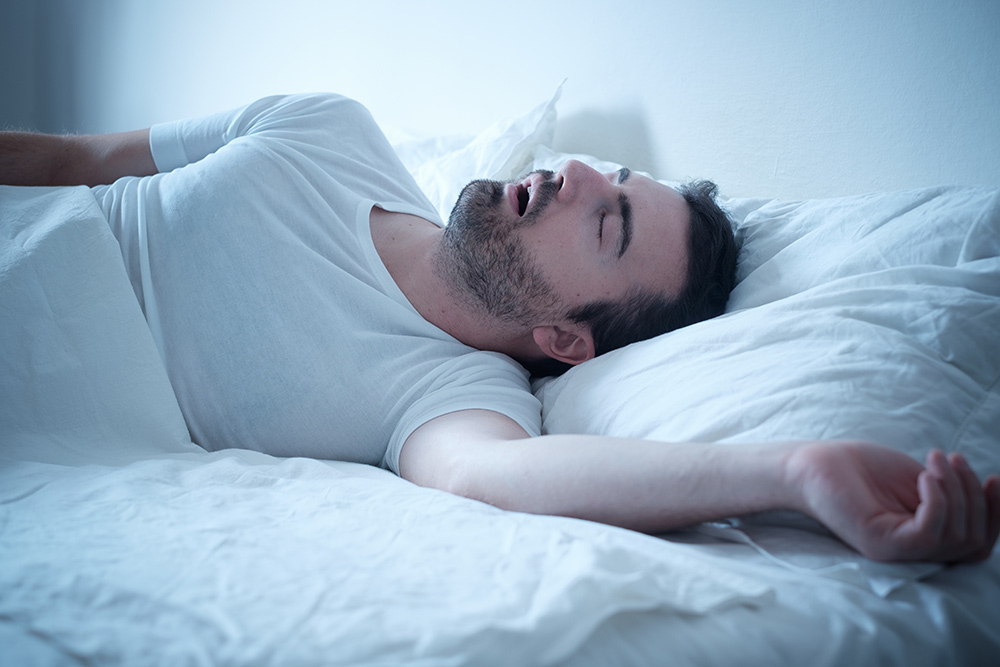
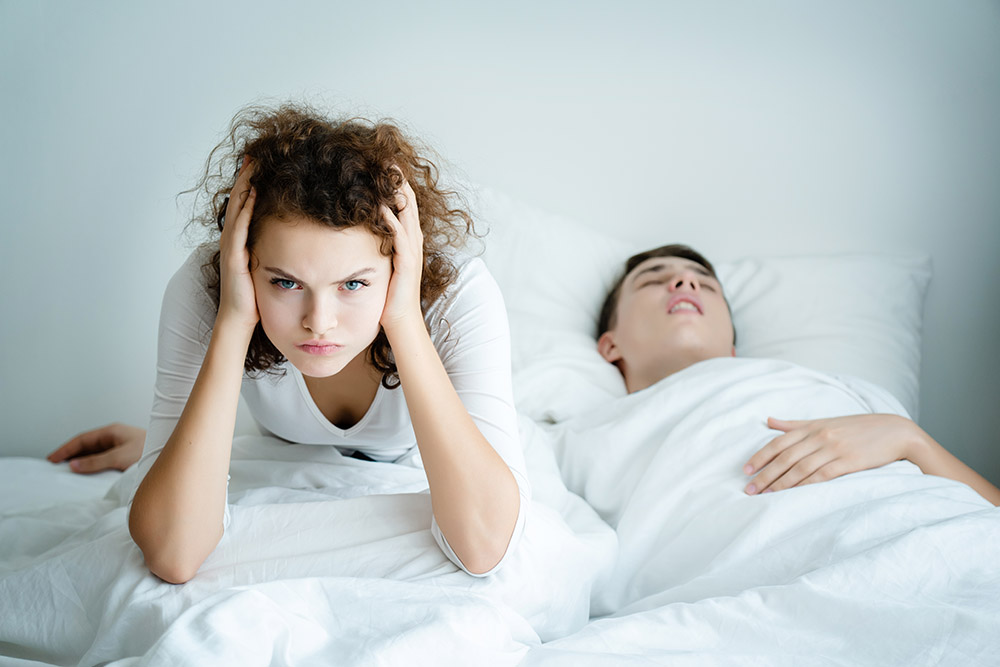
- Loud snoring, or a partner who hears you pause, choke, or gasp at night
- Waking up unrefreshed, with a dry mouth or a morning headache
- Nodding off in quiet moments, such as a long meeting or a red light
- Needing more caffeine each month to get through the same afternoon
- Worn teeth or a sore jaw from nighttime grinding, which a dentist often spots first
What happens when I visit 805 Dentistry about my sleep?
It starts with a conversation about how you sleep, how you feel during the day, and what your partner has noticed at night. Dr. Radfar, a Diplomate of the American Sleep and Breathing Academy, then examines your airway, tongue, jaw, and teeth for signs linked to sleep-disordered breathing. If testing makes sense, we help arrange a home sleep test so you can sleep in your own bed. A physician reviews the results and makes the diagnosis, and we coordinate with your medical team from there.
If I have sleep apnea, will treatment help me think more clearly?
The evidence is encouraging. In the brain imaging study, people with severe sleep apnea showed significant improvements in memory, attention, and executive function after three months of CPAP treatment, along with increases in gray matter in regions tied to memory and planning (Canessa et al., 2011). That study used CPAP, and the goal of any effective treatment is the same: keep the airway open through the night so your brain gets the rest it needs.
What if CPAP is not an option for me?
You still have a guideline-supported path. For adults with obstructive sleep apnea who cannot tolerate CPAP or prefer an alternative, sleep medicine and dental sleep medicine experts recommend a custom oral appliance over no treatment (Ramar et al., 2015). The guideline calls for a qualified dentist to provide a custom, adjustable device rather than an over-the-counter mouthguard, with follow-up sleep testing to confirm it is working (Ramar et al., 2015). It is the same path Dr. Radfar took for himself. An oral appliance is small, quiet, and easy to pack for a work trip, which matters if your schedule keeps you on the road.
Your Sharpest Workday Starts the Night Before
When work starts to feel harder, the usual fixes are more caffeine, longer hours, or a new productivity app. None of them reach the problem if it starts in your airway at 2 a.m.
Dr. Radfar made sleep a core part of 805 Dentistry because he lived the cost of missing it. He also knows how different a workday feels once breathing at night is under control.
If your focus at work has slipped and more coffee is not fixing it, you deserve to know whether sleep apnea is the reason. Call 805 Dentistry in Thousand Oaks at (805) 336-8478 for a sleep apnea screening with Dr. Radfar.
The first visit is a conversation about your sleep and your options. No pressure, no pitch.
References
Canessa, N., Castronovo, V., Cappa, S. F., Aloia, M. S., Marelli, S., Falini, A., Alemanno, F., & Ferini-Strambi, L. (2011). Obstructive sleep apnea: Brain structural changes and neurocognitive function before and after treatment. American Journal of Respiratory and Critical Care Medicine, 183(10), 1419–1426. https://doi.org/10.1164/rccm.201005-0693OC
Garbarino, S., Guglielmi, O., Sanna, A., Mancardi, G. L., & Magnavita, N. (2016). Risk of occupational accidents in workers with obstructive sleep apnea: Systematic review and meta-analysis. Sleep, 39(6), 1211–1218. https://doi.org/10.5665/sleep.5834
Jurado-Gámez, B., Guglielmi, O., Gude, F., & Buela-Casal, G. (2015). Workplace accidents, absenteeism and productivity in patients with sleep apnea. Archivos de Bronconeumología, 51(5), 213–218. https://doi.org/10.1016/j.arbr.2014.12.002
Ramar, K., Dort, L. C., Katz, S. G., Lettieri, C. J., Harrod, C. G., Thomas, S. M., & Chervin, R. D. (2015). Clinical practice guideline for the treatment of obstructive sleep apnea and snoring with oral appliance therapy: An update for 2015. Journal of Clinical Sleep Medicine, 11(7), 773–827. https://doi.org/10.5664/jcsm.4858
Van Dongen, H. P. A., Maislin, G., Mullington, J. M., & Dinges, D. F. (2003). The cumulative cost of additional wakefulness: Dose-response effects on neurobehavioral functions and sleep physiology from chronic sleep restriction and total sleep deprivation. Sleep, 26(2), 117–126. https://doi.org/10.1093/sleep/26.2.117
Young, T., Evans, L., Finn, L., & Palta, M. (1997). Estimation of the clinically diagnosed proportion of sleep apnea syndrome in middle-aged men and women. Sleep, 20(9), 705–706. https://pubmed.ncbi.nlm.nih.gov/9406321